
A research team led by Researcher Hu Liu at the Qinghai Institute of Salt Lakes, Chinese Academy of Sciences, in collaboration with researchers from City University of Hong Kong, Beijing Technology and Business University has made progress in air-tolerant magnesium-based solid-state hydrogen storage materials. Their findings have been published online in the international journal Advanced Energy Materials (Materials Science, IF = 25.5).
Against the backdrop of the global energy transition and growing demand for clean energy, efficient hydrogen storage is essential for connecting renewable hydrogen production with its transportation and utilization. Qinghai is rich in salt lake magnesium resources, which provide an important raw material basis for developing magnesium-based hydrogen storage materials. Magnesium ions (Mg2+) extracted from salt lake brines can be converted into magnesium chloride (MgCl2), which is subsequently electrolyzed to produce metallic magnesium. Through further hydrogenation, the metallic magnesium can be converted into magnesium hydride (MgH2), establishing a pathway from salt lake magnesium resources to solid-state hydrogen storage materials. With its high hydrogen storage capacity and abundant resource base, MgH2 holds considerable promise for renewable energy storage and offers a potential high-value utilization route for Qinghai’s salt lake magnesium resources. However, MgH2 is highly susceptible to oxygen and moisture in air, which generate surface passivation layers and obstruct hydrogen transport. Its sluggish hydrogen absorption and desorption kinetics, together with structural degradation during repeated cycling, further hinder practical applications. Simultaneously improving atmospheric stability, reaction kinetics, and cycling durability therefore remains a major challenge.
The collaborative research team addressed these challenges by integrating interfacial protection with spatially decoupled catalytic functions. Titled “Spatial-Decoupled Synergy between Asymmetric Ni-N3 Sites and Ni Nanoparticles Extending the Air-Tolerant Poisoning Limit of MgH2 Hydrogen Storage”, the study introduces a flexible nitrogen-doped graphene armor co-decorated with asymmetric Ni-N3 sites and Ni nanoparticles. The graphene network limits oxygen and moisture infiltration, while electronic interactions between the Ni species and MgH2 further reduce its susceptibility to atmospheric attack. At the outer interface, asymmetric Ni-N3 sites and Ni nanoparticles cooperate to promote hydrogen dissociation and spillover. At the inner interface, Ni nanoparticles react in situ to form Mg2Ni nanorivets, which facilitate hydrogen transport and stabilize contact between the protective framework and the hydride matrix during cycling. Combined experimental investigations and theoretical calculations elucidate how these coupled interfaces regulate the electronic structure and weaken Mg-H bonds. This work establishes an integrated strategy combining environmental protection, electronic modulation, and structural stabilization, offering a promising route toward durable magnesium-based hydrogen storage materials. Professors Zhenhui Ma, Bolong Huang, Wenfeng Li, and Hu Liu are the corresponding authors.
This work was supported by the Talent Youth Project of the Chinese Academy of Sciences, the National Natural Science Foundation of China, the Science and Technology Innovation Base Construction Project of Qinghai Province, the 2024 Kunlun Talents High-end Innovative and Entrepreneurial Talents Program of Qinghai Province, the Research Grants Council of Hong Kong, and start-up funding from City University of Hong Kong.
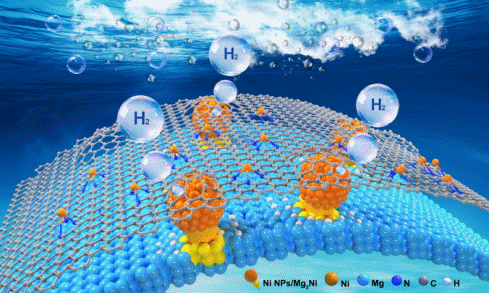
Figure 1. Schematic illustration of the graphene armor architecture and spatially decoupled catalytic synergy for air-tolerant MgH2 hydrogen storage.