
Recently, the Solution Structure and Interface Research Group (led by Professor Zhou Yongquan) at the Qinghai Institute of Salt Lakes, in collaboration with Professor Gao Yongxiang's team at Shenzhen University, achieved significant progress in the interdisciplinary field of advanced functional materials and nuclear fuel resource recovery. Through a topological distortion strategy, the research team successfully constructed a spherical metal–organic framework (MOF) micromotors featuring high water stability, fluorescence properties, and self-propulsion capabilities, demonstrating unique advantages in the study of photocatalytic uranium extraction and the biomimetic behavior of active matter. The research findings were published in Nano Research (Top Tier 1) under the title "Highly stable spherical metal-organic framework micromotors engineered via topological distortion for photocatalytic uranium extraction." The Qinghai Institute of Salt Lakes is the first affiliated institution, and Assistant Professor Ikram Muhammad is the first author.
Uranium resources are not only critical strategic materials for the development of nuclear energy but also pose long-term environmental risks due to their migration and toxicity in aquatic environments. Traditional uranium adsorbent materials are often limited by slow adsorption kinetics, insufficient selectivity, and the need for external stirring. Micro/nanomotors offer a new approach for water treatment by virtue of their autonomous motion and efficient mass transfer capabilities. However, the water stability of MOF-based motors and the regulation of their complex collective behavior remain major challenges in the field. The research team adopted a distinctive strategy by selecting a zinc-adeninate framework with large metal nodes and substituting the conventional long-chain biphenyldicarboxylic acid with short-chain terephthalic acid as the organic linker. This "topological distortion" design enhanced the hydrophobicity and steric hindrance of the metal–ligand bonds, enabling the as-constructed ZABDC micromotors to exhibit excellent long-term stability in aqueous environments. The micromotors feature a spherical vesicular structure with a diameter of approximately 2 micrometers, a hierarchical porous architecture, and a high specific surface area (1327 m²/g).
The study shows that ZABDC micromotors can achieve autonomous motion in a low-concentration hydrogen peroxide (0.3 wt%) fuel solution at a speed of approximately 7 μm/s; while their speed can be synergistically enhanced to approximately 15 μm/s upon visible light irradiation. Through COMSOL Multiphysics simulations, the team confirmed that the propulsion mechanism originates from the self-diffusiophoresis effect induced by ionic gradients generated by catalytic decomposition. In the application of uranyl ion (UO₂²⁺) extraction, the ZABDC micromotors exhibited outstanding performance. Benefiting from autonomous motion, abundant chelation sites (nitrogen/oxygen), and photocatalytic activity, the material achieved a uranium adsorption capacity up to 406 mg/g under visible light irradiation, with a distribution coefficient (Kd) of 1.0 × 10⁴ mL/g in a complex salt lake brine matrix. Notably that the uranyl ions adsorbed on the surface were further photocatalytically converted into metastable studtite nanoparticles, achieving effective immobilization and separation from the dissolved state to the solid phase.
The study also uncovered a fascinating biomimetic phenomenon: in a binary system composed of active ZABDC micromotors and passive colloidal particles, such as "predator–prey" dynamics and collective migration, which can be regulated by varying the fuel concentration. This diffusiophoretic interaction, driven by self-generated ionic gradients, provides a new model for understanding the complex dynamics of active matter and for developing intelligent micro/nanodevices.
The "all-in-one" MOF micromotor platform developed in this study integrates the structural designability of MOFs, the self-propulsion characteristics of micro/nanomotors, and photocatalytic functionality. This platform not only demonstrates application potential for the efficient extraction of radionuclides from complex water bodies but also provides a fundamental research model for exploring the nonequilibrium behavior of active matter. The related strategy can be extended to other structures within the MOF material library, opening new avenues for the development of next-generation intelligent functional materials for environmental and energy applications.
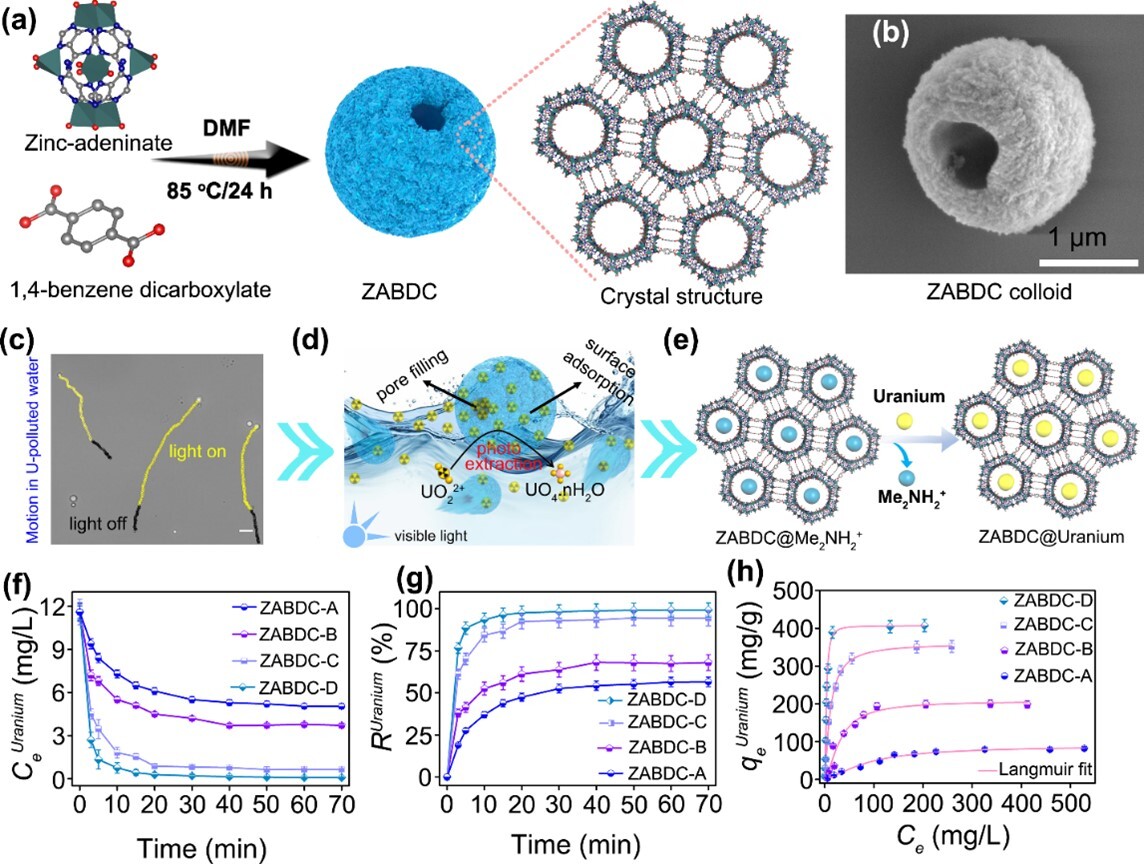
Figure 1. Synthesis and morphology of ZABDC MOF, uranium extraction under dark/light conditions with/without external H₂O₂, and a schematic diagram of uranium adsorption.
This study was supported by the International Young Scientists Project of the National Natural Science Foundation of China (Grant No. 22150410328), the Outstanding Youth Science Foundation of Qinghai Province (Grant No. 2025-ZJ-967J), the Scientific Research Fund of the Qinghai Institute of Salt Lakes, Chinese Academy of Sciences (Grant No. E355HX01), and the Kunlun Talent High-End Innovation and Entrepreneurship Talent Program. The authors acknowledge the EXAFS experimental support provided by the KEK Photon Factory (Proposal No. 2025G131).
Article link: https://doi.org/10.26599/NR.2026.94908602